A wrong police report does not decide your injury claim. In California, fault is determined from all of the evidence, and a traffic collision report is only one piece of it. Factual errors can sometimes be corrected by the agency that wrote the report, and mistaken fault conclusions can be challenged with video, witnesses, vehicle data and accident reconstruction.
Still, a report that gets the facts wrong, or blames you for a crash you did not cause, is a real problem. Insurance adjusters lean heavily on police reports in the early stages of a claim, and an error can lead to a lowball offer or an outright denial. This guide explains why police reports contain mistakes, how insurers use them, and the steps you can take to protect your claim.
Why the Police Report Carries So Much Weight
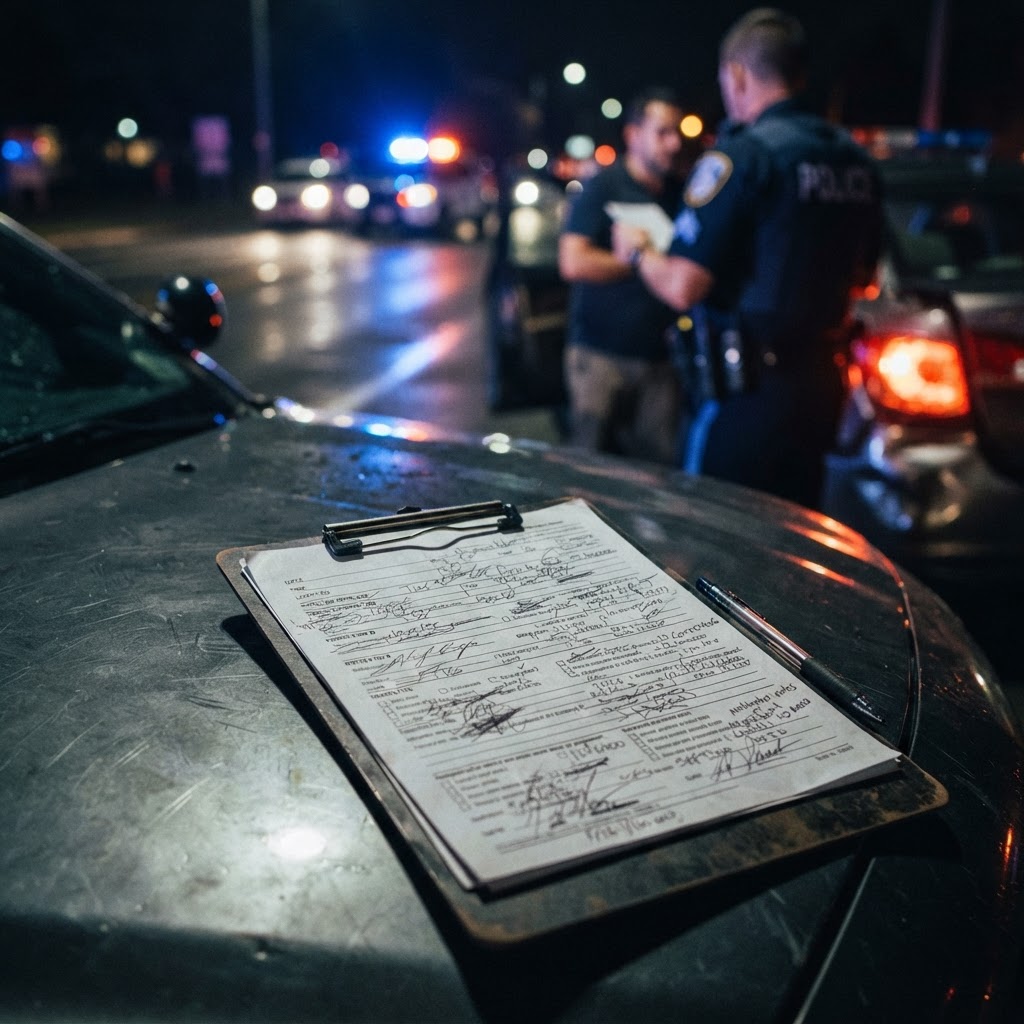
After a crash in Los Angeles, an LAPD officer, a CHP officer, or a sheriff's deputy may prepare a traffic collision report. It is often the first official record of what happened. A typical report includes:
- Names, contact details and insurance information for everyone involved
- Driver and witness statements
- Vehicle information
- Road, lighting and weather conditions
- The officer's observations
- A collision diagram
- In many cases, the officer's opinion on who caused the crash
Because it is written close in time to the crash by a neutral public official, adjusters tend to treat it as authoritative. But officers are human. They usually arrive after the collision, they rarely see it happen, and they often have limited time and incomplete information.
Does a Police Report Determine Fault in California?
No. This is the question we hear most often: "The report says the accident was my fault. Did I just lose my case?" You did not.
In California, fault is decided based on the totality of the evidence. Insurance companies, arbitrators, judges and juries can all consider evidence that never made it into the report, including:
- Surveillance and dashcam video
- Independent witness testimony
- Vehicle damage patterns
- Event data recorder ("black box") information
- Cell phone records
- Accident reconstruction analysis
- Medical records
California courts have also placed limits on how police reports can be used as evidence at trial. For example, the appellate decision in Rupf v. Yan (2000) discusses when portions of a police report may or may not be admissible. In practice, the officer's fault opinion is often far less decisive in court than adjusters make it seem during negotiations.
The Most Common Police Report Mistakes
Wrong personal, insurance or vehicle details
Misspelled names, wrong driver's license numbers, incorrect insurance information, wrong license plates, and incorrect vehicle descriptions or ownership details all appear in reports. They seem minor, but they can delay the claim or send it to the wrong insurer.
Wrong date, time, location or direction of travel
An officer might list the wrong street, intersection, time, or direction a vehicle was heading. These details become critical when you later try to match surveillance footage or witness accounts to the crash.
Inaccurate or missing witness statements
A witness may tell the officer something accurate that gets summarized incorrectly. Other witnesses leave before police arrive, or their names never make it into the report. A missing witness can change the entire fault picture.
"No injuries reported"
Many reports note that no one complained of injury at the scene. That is extremely common, because whiplash, concussions, internal bleeding and soft-tissue injuries often do not produce symptoms for hours or days. Insurers still try to use that line to argue you were not really hurt.
Flawed collision diagrams
A diagram can be persuasive visual evidence, but it can also misplace vehicles, impact points, lanes or traffic flow, creating a misleading picture of what happened.
An incorrect fault conclusion
The most damaging error is a wrong conclusion about who caused the crash, or which driver violated the Vehicle Code.
Why These Errors Happen
Most mistakes are not intentional. They usually come from ordinary circumstances:
- The officer did not see the crash. They have to reconstruct events after the fact.
- Drivers tell conflicting stories. The officer may have little to go on in choosing between them.
- Evidence disappears. Vehicles get moved, debris is swept, skid marks fade, and witnesses leave.
- Time pressure. Officers in Los Angeles often handle many calls in a shift.
- Simple human error in recording information or writing the report.
What If the Other Driver Lied to the Police?
It happens more often than people think. Some drivers panic. Some deliberately try to shift blame, even though making a false report to police can be a crime. Others genuinely misremember under stress. Common false or mistaken claims include "I had the green light," "I wasn't on my phone," "I wasn't speeding," or "they cut me off."
Because officers arrive after the fact, they may initially accept these statements. The good news is that objective evidence, such as video, phone records, vehicle data and independent witnesses, often exposes them. A false statement in a report does not have to decide the outcome of your claim.
How Insurers Use a Wrong Report Against You
Here is the insider reality: an adjuster's job is to resolve claims for as little as the facts allow. An unfavorable police report gives them an easy, official-looking reason to do that. Adjusters commonly point to the officer's fault opinion, missing witnesses, an inaccurate diagram, or an incomplete statement to:
- Make a reduced settlement offer
- Delay the claim while they "investigate"
- Deny the claim outright
- Argue that you share a large percentage of the blame
Defense attorneys also use reports to attack your credibility if your account differs from what the officer wrote. For more on these tactics, see our list of 13 insider insurance adjuster tricks to know.
Comparative Fault: Why a Wrong Report Can Cost You Real Money
California follows a pure comparative negligence system, adopted by the California Supreme Court in Li v. Yellow Cab Co. (1975). You can recover compensation even if you were partly at fault, but your recovery is reduced by your share of responsibility.
That makes the fault percentage a direct lever on the value of your claim:
- $100,000 in damages and 20% fault = $80,000 recovery
- $100,000 in damages and 40% fault = $60,000 recovery
Insurers know this, so they use any unfavorable line in a police report to push your percentage higher. In larger injury cases, a mistaken fault finding can shift the value of a claim by a very large amount. That is why challenging inaccuracies early matters.
What to Do If Your Police Report Is Wrong
A wrong report is a hurdle, not the end of your claim. Many successful cases start with an incomplete or incorrect report. The key is to act quickly and methodically.
1. Get a copy and read every line
Request the report as soon as it is available. In Los Angeles, you can request an LAPD traffic collision report; for freeway and unincorporated-area crashes, you can request a crash report from the CHP. Check names, addresses, vehicle and insurance information, witnesses, statements, the date, time and location, the diagram, and any fault conclusions.
2. List every error
For each mistake, write down what the report says, why it is wrong, and what evidence supports your version. An organized list makes it much easier to request corrections and to rebut the report later.
3. Preserve evidence right away
Save your photos and videos of the scene and vehicles, dashcam footage, repair estimates, medical records, and any witness contact information. For a detailed checklist, read our insider guide to gathering car accident evidence.
4. Chase down video before it is deleted
Many LA intersections, businesses, apartment buildings and homes have cameras. That footage is often automatically overwritten within days or weeks. Ask nearby businesses immediately, or have an attorney send preservation requests.
5. Contact independent witnesses
Independent witnesses have no stake in the outcome, which makes them very persuasive. They can speak to who had the light, speeds, lane changes, phone use, and right-of-way. In disputed-fault cases, witness testimony is often what overcomes a mistaken report. Reach out while memories are fresh.
6. Talk to a lawyer before giving a recorded statement
An attorney can evaluate the report, identify its weaknesses, preserve evidence, and plan how to challenge it. The earlier a lawyer gets involved, the more evidence is still available.
Can You Correct a Police Report in California?
It depends on the type of mistake.
- Factual errors such as names, addresses, vehicle details, dates or locations can often be corrected by contacting the reporting agency with documentation.
- Disputed conclusions about fault are much harder to change. Officers are generally reluctant to revise an opinion once the report is complete. In some cases, you may be able to submit a supplemental statement that is added to the file.
The key point: the report does not have to be formally amended for you to win. Your attorney can show that the officer lacked key information, relied on inaccurate statements, or misapplied the traffic laws, so the report becomes just one piece of evidence rather than the deciding factor.
Evidence That Can Overcome a Wrong Report
- Surveillance video often provides an objective record of what happened.
- Dashcam footage is increasingly common and very persuasive in disputed crashes.
- Event data recorders in many modern vehicles capture speed, braking, steering and acceleration in the moments before impact.
- Cell phone records can help show distracted driving.
- Vehicle damage analysis helps show angles and points of impact.
- Accident reconstruction. Specialists analyze impact angles, vehicle movement, physical evidence and road conditions. Learn more in what an accident reconstruction expert does.
- Medical records help establish the timing, severity and cause of injuries.
Disputed-liability cases can still be resolved successfully. One example from our firm is a disputed freeway lane change case, where fault was contested.
Police Report Errors in Other Types of Crashes
- Motorcycle crashes: riders are sometimes blamed based on assumptions about speed or lane position rather than evidence, and visibility problems are overlooked. See our motorcycle accident practice page.
- Pedestrian accidents: reports may wrongly state the pedestrian was outside a crosswalk, not paying attention, or gave the driver no time to react. Video frequently tells a different story.
- Bicycle accidents: officers may misunderstand bike lane rights, safe-passing rules, or right-of-way.
- Truck accidents: a brief roadside investigation rarely uncovers driver fatigue, hours-of-service violations, poor maintenance, or cargo problems. Independent investigation is often essential.
How an Adjuster Actually Reads Your Police Report
When a claim file opens, the adjuster typically pulls the police report within the first few days. From the insurance side, the report is used to answer a few quick questions: Who does the officer say caused the crash? Was anyone cited? Did anyone report injuries at the scene? Are there independent witnesses listed? Is there anything in the narrative, such as a driver saying "I didn't see them," that looks like an admission?
Those answers often set the tone of the entire claim. If the report favors the insurer's policyholder, the adjuster may make an early liability decision and stop looking further. That is why a wrong report can quietly steer a claim toward denial before anyone considers the video from the gas station on the corner or the witness who was never interviewed.
It also works the other way. When you give the adjuster organized, objective evidence that contradicts the report, such as footage, a witness statement, or a reconstruction, they have to reevaluate liability. Adjusters generally document their reasons for liability decisions, and a decision that ignores clear contrary evidence is harder to defend internally and in litigation.
Why Independent Witnesses Matter So Much
In a two-driver dispute, each side has an obvious interest in the outcome. An independent witness, such as a pedestrian on the corner, a driver in the next lane, or a store employee who saw the collision, does not. Their account can clarify the signal phase, vehicle speeds, lane changes, whether someone was looking at a phone, and who had the right-of-way.
Unfortunately, witnesses are often the first thing lost after a crash. They leave before police arrive, or the officer never takes their information. If anyone stopped to help you, gave you a business card, or posted about the crash online, try to follow up. An attorney or investigator can also canvass the area, locate witnesses, and take recorded statements before memories fade. In many disputed-liability cases, a single credible witness is what turns an unfavorable report around.
Quick Answers
Should I just accept the report if it blames me? No. Accepting a wrong fault finding can mean a denied claim and unpaid medical bills. Many successful claims began with incomplete or incorrect reports.
Will the officer testify? Sometimes, if the case goes to trial. But an officer who did not witness the crash can be questioned about what information they had, and what they did not.
Does a citation mean I was at fault? Not necessarily. A traffic citation and civil liability for an injury claim are separate questions, and the evidence in your injury case can point to a different conclusion.
Mistakes to Avoid
- Do not assume you have no case because the report blames you.
- Do not give a recorded statement to the other driver's insurer without preparation or legal advice. Adjusters are trained to ask questions that can be used against you.
- Do not overstate the report's errors. If only parts are wrong, say so; exaggeration hurts your credibility.
- Do not confront the other driver.
- Do not delay medical care. Gaps in treatment hurt a claim more than a report error ever will.
- Do not discuss fault on social media.
- Do not wait. Evidence disappears and legal deadlines apply.
Watch the Deadlines
Errors in a police report do not pause California's filing deadlines. The general deadline for personal injury lawsuits is two years from the date of injury, and claims against government entities usually require a written claim within six months. Because deadlines vary by case, get legal advice promptly.
The Truth Can Still Win
A wrong police report is frustrating, but it is not the final word. By acting quickly, preserving evidence, finding witnesses, and working with an attorney who knows how insurers evaluate these disputes, you can challenge the errors and protect your right to compensation. Our founder previously worked as a senior insurance defense attorney and in-house counsel for a major auto insurer, so we know how adjusters use police reports and how to respond.
If you were hurt in a crash and the report gets it wrong, our Los Angeles car accident attorneys can help. Contact Insider Accident Lawyers for a free case review or call 424-INSIDER. You pay no attorney's fee unless we recover compensation for you.