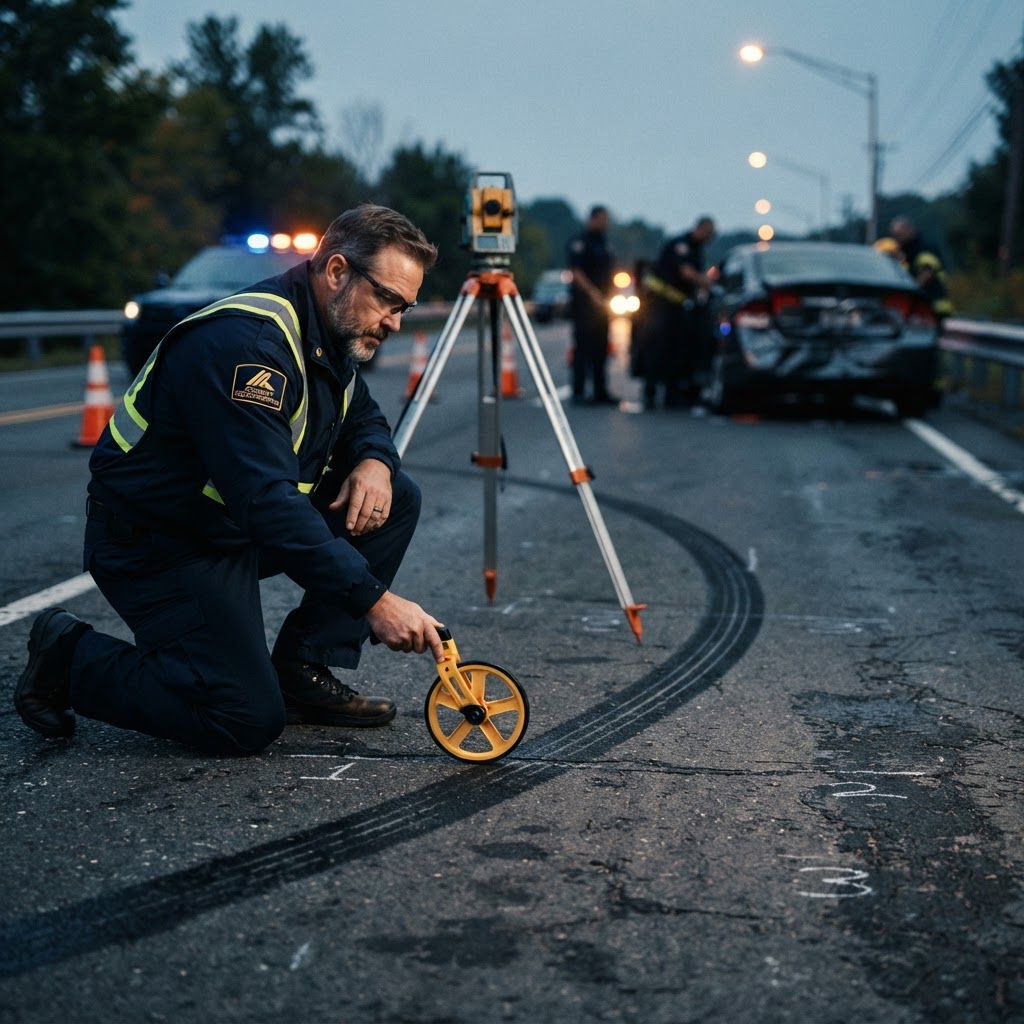
An accident reconstruction expert is a trained crash investigator, usually an engineer, physicist or trained collision investigator, who uses physical evidence, vehicle data and scientific calculations to determine how and why a crash happened. Their findings can establish speeds, positions and timing, show who was at fault and counter an insurance company's attempt to shift blame. They matter most when fault is disputed or the injuries are serious.
When Everyone Tells a Different Story
After a serious crash, the most important question often turns out to be the hardest one: what actually happened? You know what you experienced in those few seconds. The other driver may tell a completely different story. Witnesses may remember events differently, or not at all. Police officers try hard to capture the facts, but they arrive after the crash and sometimes get it wrong.
Some of those differences are honest: people see things from different angles and remember details differently. Sometimes a person is simply not telling the truth. Either way, the confusion creates an opening for an insurance company to dispute liability and reduce or deny payment.
That is where accident reconstruction comes in. By relying on measurable evidence rather than memory, a reconstructionist can often cut through conflicting accounts and give an objective explanation of the crash, one that can support a claim, strengthen negotiations and help secure fair compensation.
What Is an Accident Reconstruction Expert?
A reconstructionist investigates collisions and uses scientific methods to recreate the sequence of events. Many are mechanical or civil engineers, former law enforcement collision investigators, physicists or professionals with extensive training in crash analysis. Their conclusions are based on data and physical principles, not assumptions.
They commonly work on:
- Car accidents and rideshare crashes
- Truck and commercial vehicle collisions
- Motorcycle and bicycle accidents
- Pedestrian accidents
- Wrongful death cases
Why Reconstruction Matters
Crashes that look simple at first often raise hard questions:
- Who had the right of way?
- How fast was each vehicle going?
- Did someone run a red light?
- Was a driver distracted or violating another traffic law?
- Did a vehicle change lanes suddenly?
- Was more than one driver responsible?
- Could the crash have been avoided?
- Did a mechanical failure or road condition contribute?
When fault is disputed, insurers push back hard. Without solid evidence, an injured person can struggle to prove their case, which affects how much they recover for medical bills, lost income and pain and suffering, or whether they recover anything at all. Reconstruction supplies objective answers, and in many disputed cases it becomes some of the most persuasive evidence available.
Our founding attorney, Shawn Rokni, who previously worked as a senior insurance defense attorney and in-house counsel for a major auto insurer, describes how the firm uses them:
"Accident reconstruction experts are usually engineers, and they are very experienced in reconstructing accidents as to what happened and who's at fault. We use accident recon experts to evaluate liability and often they will have access to software that is really useful. For example, they can put in a video of an accident happening and the software can say how fast the cars were going."
He adds that reconstructionists can download a vehicle's electronic data recorder, which may show what the driver was doing before the crash, how fast they were going, whether they braked and whether they steered to avoid the collision. That is technical work most lawyers, and certainly most drivers, cannot do themselves.
What Does a Reconstructionist Actually Do?
The job goes well beyond looking at a few photos. A thorough reconstruction pulls together several types of technical evidence.
Studying the Scene
Reconstructionists look at tire and skid marks, gouges in the pavement, debris fields, where the vehicles came to rest, road surface conditions, signs and signals, lighting and sight lines. Small details, like the start of a skid mark or the spread of broken glass, can reveal a lot about speed and angle.
Inspecting the Vehicles
Every damaged vehicle tells a story. Reconstructionists examine impact points, crush depth, airbag deployment, seat belt use and mechanical systems such as steering and brakes. The location and severity of damage help establish collision angles, speeds and movements.
Reviewing the Police Report
They review officers' observations, measurements, diagrams, witness statements, citations and preliminary fault findings, but they do not simply accept the report's conclusions. They independently test them against the physical evidence. If you believe the report got it wrong, see our tips on what to do about an inaccurate police report.
Testing Witness Accounts
Witness statements are compared against the physical evidence. Where a statement does not fit the physics, the inconsistency can be identified and explained, creating a more accurate picture of what really happened.
Analyzing Electronic Data
Many modern vehicles have event data recorders, often called black boxes, which may capture speed, brake application, steering input, accelerator position, seat belt status and airbag timing in the moments around a crash. Commercial trucks may have additional electronic systems. This data can be extremely valuable.
Reviewing Video
Traffic cameras, business security systems, dashcams and cell phone recordings can show vehicle movements and driver behavior. Reconstructionists can analyze footage frame by frame to calculate speed and timing. Our guide to car accident evidence explains how to help preserve this kind of proof.
How Reconstruction Helps Establish Fault
Insurers frequently deny liability or try to shift blame to the injured person. Reconstruction evidence can show, for example, that a driver was speeding, failed to yield, made an unsafe lane change, reacted too late because they were distracted, violated trucking safety rules, or that a vehicle defect contributed. The analysis explains not only who was responsible but why.
The Science Behind It
Reconstruction draws on physics, engineering, mathematics, vehicle dynamics and human factors analysis. Reconstructionists calculate vehicle speeds, braking distances, perception-reaction times, impact forces and trajectories. Because the method is scientific and testable, courts and insurers often find well-supported reconstruction evidence highly credible.
Human factors analysis deserves a special mention. It looks at how real people perceive and react to hazards: how long it takes an average driver to notice a pedestrian stepping off a curb at night, recognize the danger and get a foot on the brake. That perception-reaction window, combined with speed, determines whether a crash was avoidable. A driver who says "they came out of nowhere" may have had more than enough time to stop if they had been watching the road and traveling at the speed limit. Human factors work turns that argument into numbers.
Common Tools
- Laser scanning: creates detailed 3D models of the scene and preserves precise measurements.
- Drones: capture aerial views of road layouts and vehicle positions.
- Computer simulation: recreates the crash digitally and tests which scenario fits the evidence most closely.
- Photogrammetry: uses photographs to generate measurements and 3D models, which is useful when the scene has changed.
Cases Where Reconstruction Is Especially Important
Not every case needs one. In a straightforward crash where liability is clear, it may be unnecessary. It often becomes crucial in:
- Fatal crashes. Wrongful death claims involve high stakes and frequent disputes about exactly how the crash happened.
- Catastrophic injury cases. The bigger the potential payout, the harder insurers fight liability.
- Multi-vehicle collisions. Chain-reaction crashes can involve shared fault among several drivers. See how fault is determined in a multi-car pileup.
- Truck crashes. Fatigue, speed, cargo loading, brake failures and federal safety violations all require technical analysis. Trucking companies often send rapid-response teams to the scene right away, and victims need an equally prompt investigation.
- Pedestrian and bicycle crashes. Drivers often say they never saw the person. Reconstruction can test visibility, reaction time and the point of impact to show whether the crash was avoidable.
Proving Speeding, Distraction and Truck Driver Negligence
Speeding: Speed analysis is one of the most common uses of reconstruction. Using skid marks, crush damage, impact forces, post-impact movement and event data, reconstructionists can often estimate how fast a vehicle was going, which is powerful when a driver denies speeding.
Distraction: A reconstructionist cannot always identify the specific distraction, but delayed braking, no evasive action, failure to steer away and an unusual vehicle path can point to inattention. Combined with phone records, those findings can help prove distracted driving.
Truck negligence: Analysis of truck speed, brake performance, reaction time, hours-of-service records, cargo issues and maintenance files can reveal negligence that would otherwise stay hidden.
How Insurers Use Their Own Reconstructionists
Insurance companies hire reconstructionists too, and their goal is to limit what the insurer pays. Their analysis may shift blame to the victim, minimize the insured driver's role, challenge the injuries or support an alternative theory of the crash. From the insurance side, a defense reconstruction report can be a tool to justify a low offer. An injury lawyer can retain an independent reconstructionist to test those conclusions and expose weak assumptions. As one example, our firm obtained a $500,000 result in a rear-end crash case after defeating a "ghost vehicle" defense. Past results do not predict the outcome of any other case.
Questions to Ask About a Reconstruction Report
Whether a report comes from your side or the insurer's, it is only as good as its inputs. Useful questions include:
- Did the reconstructionist inspect the vehicles and scene in person, or rely only on photos?
- Was event data recorder information downloaded and properly interpreted?
- Were all available videos reviewed, and were their frame rates verified?
- Which witness statements were accepted or rejected, and why?
- Does the analysis account for road grade, surface conditions, lighting and weather?
- Do the conclusions hold up if one assumption, such as a friction value, changes?
Weak answers to these questions are often where a defense reconstruction can be challenged.
How Reconstruction Evidence Is Used in Court
If a case goes to trial, reconstructionists testify as expert witnesses, translating technical findings into terms judges and jurors can follow. They may use photos, diagrams, calculations, animations, simulations and 3D models. Courts evaluate a reconstructionist's education, training, experience, certifications, publications and prior testimony, and stronger credentials make testimony more persuasive. Many hold backgrounds in mechanical or civil engineering, physics, human factors or traffic collision investigation, along with certifications in reconstruction.
Why Timing Matters
Evidence disappears fast. Skid marks fade. Vehicles are repaired or scrapped. Surveillance footage is deleted. Witness memories weaken. The sooner an investigation starts, the better the chance of preserving what a reconstructionist needs, which is why many injury lawyers begin investigating serious crashes as soon as they are retained.
How Reconstruction Can Affect Case Value
The strength of a claim depends on the quality of its evidence. Solid reconstruction work can strengthen liability arguments, improve negotiating leverage and add credibility in court. When liability is disputed, it can be the deciding factor, and insurers are often more willing to negotiate fairly when faced with a well-supported scientific analysis. For people with serious injuries, that can change the outcome of the case.
How Much Does an Accident Reconstruction Expert Cost?
Reconstruction is not cheap. Reconstructionists typically require a retainer of several thousand dollars, and industry data show hourly rates commonly range from about $250 to $375. Complex cases involving testing, simulations and trial testimony cost more. As Shawn Rokni explains, "We usually only hire them if there's a liability dispute because they are very expensive. They can cost tens of thousands of dollars by the time they're done at trial."
Clients do not pay those costs upfront. Our firm advances case costs, and you pay no attorney's fee unless we recover compensation for you. We will explain exactly how costs are handled, in writing, before you sign.
What You Can Do Now If Fault Is Disputed
You do not need to hire a reconstructionist yourself, but you can protect the evidence one would need:
- Keep your vehicle. Ask your insurer and the tow yard not to salvage or repair it until your lawyer has had it inspected.
- Save your photos and videos in their original form, with the original date and location data.
- Write down what you remember as soon as possible: your lane, speed, the signal color and what the other driver did.
- List nearby cameras at businesses, homes and intersections so preservation requests can go out quickly.
- Do not give a recorded statement to the other driver's insurer about how the crash happened until you have had legal advice.
These steps take little effort in the moment and can make the difference between a disputed claim and a provable one.
The Bottom Line
Accident reconstruction goes far beyond reviewing photos or reading a police report. It uses science, engineering, technology and physical evidence to uncover how a crash really happened. When liability is disputed, those findings can establish fault, strengthen an injury claim and help victims facing medical bills and lost income get fair compensation.
If you or a loved one was hurt in a crash where fault is being disputed, Insider Accident Lawyers can investigate, bringing in a reconstructionist when the case calls for it. Call 424-INSIDER or request a free case evaluation.