Premises liability is the area of law that holds property owners and occupiers responsible when an unsafe condition on their property injures someone who is lawfully there. To win a claim in California, you generally must show that a dangerous condition created an unreasonable risk of harm, that the owner knew or should have known about it, and that the owner failed to fix it or warn about it. Premises injury lawyers investigate those elements, preserve evidence, and deal with the owner's insurer.
If you slipped on a wet grocery store floor, tripped on a broken sidewalk, or were hit by merchandise falling from a shelf, you may be wondering whether it was just bad luck or your own fault. Often it was neither. Stores, landlords, hotels, cities and other property owners have legal duties to keep their premises reasonably safe. This guide explains how those duties work and when a property owner can be held responsible.
What Is Premises Liability?
Our founding attorney, Shawn Rokni, sums it up simply: "Premises liability cases are about unsafe conditions." When a dangerous condition on a property injures someone with a legal right to be there, premises liability law may allow that person to recover compensation.
These cases arise almost anywhere people go, including:
- Grocery stores and shopping malls
- Apartment complexes and private homes
- Hotels and restaurants
- Parking lots and garages
- Office buildings and construction sites
- Sidewalks, public parks and other government property
The central question is usually whether the owner knew about the danger and failed to deal with it, or whether the danger existed long enough that a reasonable owner using ordinary care would have discovered and fixed it.
The Three Elements of a Premises Liability Claim
An injury on someone else's property does not automatically mean the owner is liable. As Shawn explains, "There are three elements that must be met for a defendant to be liable and have to pay or compensate an injured victim."
1. A condition created an unreasonable risk of harm
There must be a dangerous condition, such as a wet floor, broken stairs, an uneven sidewalk, a hidden hole, unstable merchandise, poor lighting, exposed wiring, or a loose handrail. In Shawn's words, "The condition creates an unreasonable risk of harm." Not every condition qualifies. A clearly visible parking block, for instance, usually is not an unreasonable danger because people expect it.
2. The owner knew or should have known about it
This is called notice. An owner may be liable if it created the hazard, actually knew about it, or would have discovered it through reasonable inspections. If a store employee spills water, the store is generally treated as aware of the hazard because its own employee caused it. If a hazard sits long enough that a reasonable inspection would have caught it, the owner may be responsible even without actual knowledge.
3. The owner failed to fix it or warn about it
Finally, the owner must have failed to act reasonably, for example by not repairing a defect, not cleaning up a spill, not posting a warning, or not blocking off a dangerous area.
Why the Law Puts This Duty on Property Owners
Premises liability is not about blaming owners for every accident. It reflects a practical reality: owners know far more about their property than visitors do. Edward Yim, a Senior Litigation Attorney at our firm, puts it this way: "If you are holding your property out and inviting people onto your property, it's presumed you know what's going on on your property... The law understands a landowner is going to know more about the property than any invitee who enters that property."
A shopper has no way of knowing whether a staircase is structurally sound, whether merchandise above them was stacked safely, or whether the puddle ahead has been there for hours. The owner is in the best position to find and fix those dangers before someone gets hurt.
Common Types of Premises Liability Cases
Slip and falls
Slip and fall accidents are among the most common premises claims, often caused by spilled liquids, leaking refrigerators, freshly mopped floors, or oil and grease. Edward notes, "A person walking and suddenly slipping on a substance like water, oftentimes those result in the most serious injuries that we see." Shawn adds that the phrase undersells the harm: "When you say 'slip and fall' everyone thinks, 'Okay, maybe your back hurts a little bit.' That's not the case. These falls can cause serious injuries." Our slip and fall insider tips cover what to do after a fall.
Hidden structural defects
Some hazards are concealed entirely. Edward recalls a case involving a carpeted floor: "When my client stepped in that area, the foot went right through the carpet into the floor. That's a condition they would not otherwise have known about, so it would be up to the property owner to warn that person." Because victims have no chance to avoid hidden defects, these claims can be especially strong.
Sidewalk defects
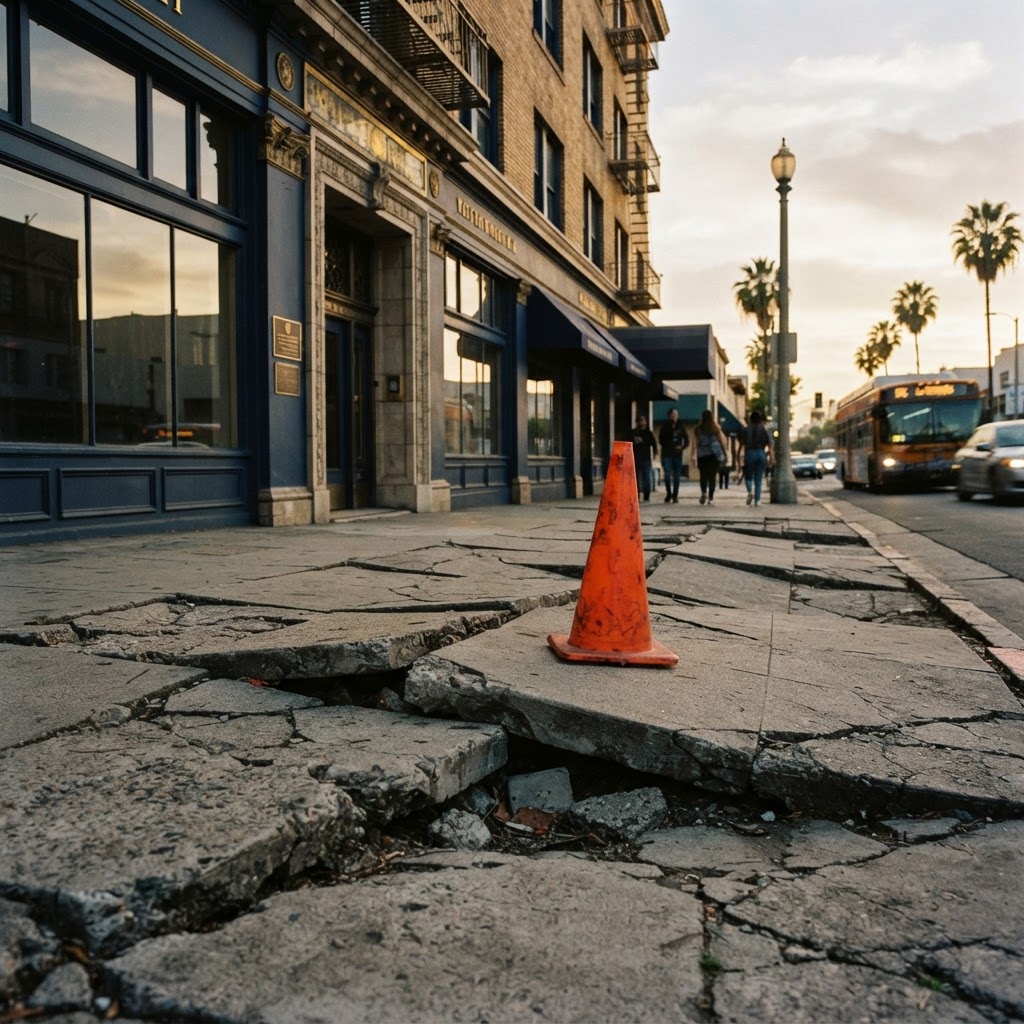
Tree roots, shifting soil and aging infrastructure create raised or broken slabs that cause pedestrians to trip. Cities and other public entities may be liable when they fail to maintain walkways. Claims against government entities come with special rules and short deadlines, generally requiring a written claim within six months of the injury.
Falling merchandise
Improperly stacked goods can fall on shoppers and cause concussions, traumatic brain injuries, neck and shoulder injuries, and facial fractures. These incidents are usually preventable with proper training and safe stocking practices. We explain who is responsible in our article on supermarket injury claims from falling merchandise.
Dangerous staircases
Broken steps, loose handrails, poor lighting and building code violations can turn a staircase into a serious hazard. Falls on stairs often involve multiple impacts, so injuries tend to be severe.
Injuries in Premises Cases Are Often Serious
A common misconception is that premises claims involve only minor injuries. Shawn explains why that is wrong: "When you're in an auto accident... You have airbags, you have a car protecting you... In a slip and fall case, you don't have anything in between your head and the concrete floor."
Common injuries include broken ankles and wrists, hip fractures, knee injuries, concussions and traumatic brain injuries, herniated discs, spinal injuries, shoulder injuries, and facial fractures. Serious cases may require surgery, extended rehabilitation, or long-term care.
The "Open and Obvious" Defense
Property owners often argue that a hazard was "open and obvious," meaning you should have seen and avoided it. A bright yellow sign placed right in front of a spill may support that defense. But many hazards are not nearly as obvious as owners claim:
- Clear liquids blend into many floor surfaces.
- Poor lighting can hide defects.
- Structural problems may be impossible to see.
- Falling merchandise gives no warning at all.
As Edward says, "Sometimes the condition is not open and obvious because it blends in with the floor." Shawn frames the key question: "The common factor here is the person who's walking could not have seen it coming, as a reasonable person, and could not avoid the danger." Each case depends on its facts, and even when a hazard was somewhat visible, California's comparative fault rules may reduce rather than eliminate a recovery.
Evidence That Can Make or Break Your Claim
Even a strong claim becomes hard to prove if the evidence disappears. Shawn's advice is direct: "You want people to take pictures of it. You want them to preserve that evidence so the attorney can evaluate the condition. A picture of it, a video of it, can be really helpful if there's something wrong with that premises."
- Photos of the wet floor, broken step, damaged sidewalk, missing warning signs, or poor lighting, taken as soon as possible.
- Video. Surveillance footage can show what happened and how long a hazard existed. Edward warns that it does not last: "Most companies have a retention schedule for surveillance footage... Video evidence is one piece of evidence that seems to disappear relatively quickly." Many systems overwrite footage automatically unless the business receives a preservation request.
- Witnesses who can describe how the fall happened, how long the condition was there, whether employees knew, and whether any warnings were posted.
- Incident reports. Many businesses prepare internal reports after an injury. Ask that one be made, and note the names of employees you speak with.
What Compensation May Be Available
If a property owner is responsible for your injuries, a premises liability claim can seek the same kinds of damages as other California injury cases, including:
- Past and future medical expenses, such as emergency care, surgery, therapy and medication
- Lost wages and, for lasting injuries, loss of future earning capacity
- Pain and suffering and emotional distress
- Loss of enjoyment of life
- Out-of-pocket costs such as transportation to appointments and household help
The value of a claim depends heavily on the severity of the injury, how clearly the owner's notice can be proven, and whether the owner argues you share some of the fault.
What to Do Right After an Injury on Someone's Property
- Get medical care, and describe exactly how you were injured.
- Report the incident to the manager, landlord or owner, and ask for a copy of any incident report.
- Photograph the hazard, the surrounding area, any lack of warning signs, and your injuries.
- Keep the shoes and clothing you were wearing.
- Get names and phone numbers of witnesses and employees.
- Avoid giving a recorded statement to the owner's insurer before getting advice.
How Insurers Handle Premises Claims
From his years working on the insurance side, Shawn knows the script: "The adjuster is going to act like a friend. They're not going to act like they're trying to save their own company money. They're going to say, 'We want to take care of you. We want to pay your medical bills.' They're going to be very nice and friendly, but their intention is to resolve that case and get a release signed."
Expect requests for a recorded statement, broad medical authorizations, and a quick offer paired with a release. Settling too early is one of the biggest risks. "Once they have a signed release of your claims, you cannot bring an injury claim later," Shawn warns. Edward agrees: "You need to make sure you are completely healed before we start talking settlement. Because once you sign that release... you can't go reopen it later."
Well-documented premises claims can be resolved successfully. One example from our firm is a supermarket wet-floor injury case.
Don't Blame Yourself
Many people feel embarrassed after a fall and assume they must have been careless. That reaction is understandable, but often wrong. Edward reminds clients, "You are entitled to walk around a store and do that safely," and, "This is not your fault. All you were doing was walking and shopping." Customers, tenants and guests have a right to expect reasonably safe premises. When an owner ignores a hazard, the responsibility belongs with the owner.
When to Talk to a Premises Injury Lawyer
The sooner, the better, because evidence can disappear within days. Even if you are not sure you have a case, a free consultation can help you understand whether negligence occurred, who may be responsible, what evidence to preserve, and what compensation may be available.
If you were hurt by an unsafe condition on someone else's property in Los Angeles, contact Insider Accident Lawyers for a free case review or call 424-INSIDER. You pay no attorney's fee unless we recover compensation for you.